

How to Calculate ARV for a Fix and Flip in East Tennessee
Every fix and flip in East Tennessee lives or dies on one number: the After Repair Value. At Approach Lending, we've underwritten hundreds of these deals across the region and watched that single figure make or break projects from Knoxville to the Tri-Cities. Get it wrong by $30,000 and you've wiped out your margin before the first nail goes in.
Knoxville's historic neighborhoods, Chattanooga's dual-tax corridors, the Tri-Cities, and Sevier County's cabin economy each require a completely different approach to ARV.
What works in West Knoxville will mislead you in Fourth and Gill.
Key Takeaways
- ARV is the underwriting ceiling for every cost in your deal: purchase, rehab, carry, and profit.
- The 70% rule shifts by submarket: competitive areas may allow 75-78% of ARV; historic or rural deals often require 60-65%.
- Walkout basements appraise at 40-60% of above-grade square footage. Blending them into a single price-per-square-foot figure is one of the most common ARV errors in this market.
- A bedroom beyond the TDEC septic permit capacity cannot be legally marketed or appraised as a bedroom, which costs $15,000 to $35,000 in ARV.
- We lend up to 70% of ARV on fix and flip deals and have funded 300-plus loans across East Tennessee, including small towns most lenders won't touch.
In This Article
- What ARV Actually Means for a Fix and Flip
- The 70% Rule and How to Apply It in East Tennessee
- How to Find and Qualify Comps Across East Tennessee
- Gross Living Area, Basements, and the ANSI Trap
- The Septic Bedroom Restriction That Can Wreck Your ARV
- Submarket Nuances: Knoxville, Chattanooga, Tri-Cities, and Sevier County
- Building the Full Maximum Allowable Offer Stack
- How We Underwrite Fix and Flip Deals at Approach Lending
- Frequently Asked Questions
What ARV Actually Means for a Fix and Flip
After Repair Value is the projected fair market value of a property once it's fully renovated to the prevailing finish standard in its submarket. In practice, ARV is the ceiling against which every other number in your deal is measured: acquisition cost, construction budget, debt limit, carrying costs, and target profit. If your ARV is inflated by $40,000, your loan is undersized relative to actual risk and your profit evaporates at disposition.
ARV isn't an optimistic sales target. It's an underwriting constraint built from evidence, not hope.
Two methodologies establish ARV. The Paired Sales Adjustment Model pulls recent arm's-length sales of renovated comparables in the same micro-market, then adjusts each comp up or down for specific differences from your projected post-renovation condition. The Adjusted Price Per Square Foot approach works as a secondary cross-check in homogenous subdivisions, but breaks down fast in East Tennessee because topographical shifts, foundation configurations, and unpermitted square footage cause wide price swings between properties on the same street.
Use it to confirm, not to lead.
The 70% Rule and How to Apply It in East Tennessee
The 70% rule states that your maximum purchase price should be no more than 70% of ARV, minus your estimated repair costs.
Maximum Allowable Offer = (ARV x 0.70) minus Estimated Repair Costs
Example: ARV of $300,000, rehab estimate of $60,000. $300,000 x 0.70 = $210,000, minus $60,000 = $150,000 maximum offer. That 30% isn't pure profit. It absorbs origination points, monthly interest carry, taxes, insurance, broker commissions at disposition, and your net margin.
Strip all of that out and a 70% ceiling typically leaves a net return of 12-18% of ARV on a well-run project.
The multiplier shifts by submarket. In competitive areas like West Knoxville or Chattanooga's NorthShore, experienced investors sometimes push to 75-78% of ARV. In rural districts or historic infill with structural unknowns, the target shrinks to 60-65%.
Net margins on flips have been compressing nationally, so a conservative ARV is your protection when the market doesn't cooperate.
How to Find and Qualify Comps Across East Tennessee
National aggregators like Zillow and Redfin are useful for orientation, not for underwriting. Accurate ARV work requires primary MLS data. East Tennessee REALTORS® (formerly KAARMLS) covers the Knoxville metro across 12 counties.
The Greater Chattanooga Association of REALTORS® (GCAR) covers Hamilton, Bradley, and adjacent counties. Tennessee Virginia Regional MLS (TVRMLS) handles Northeast Tennessee. Great Smoky Mountains MLS (GSMMLS) covers Sevier County.
Reciprocal sharing through FlexMLS lets you pull comps near county boundaries.
East Tennessee's topography breaks the standard one-mile comp radius. In dense urban neighborhoods like Fourth and Gill, Old North Knoxville, NorthShore, or Highland Park, compress the radius to 0.25 to 0.5 miles. Crossing an arterial road or historic overlay boundary shifts values materially.
In rural areas across Anderson, Blount, Loudon, or Roane counties, expand to 1 to 3 miles. In Sevier County's cabin market, forget the radius entirely: comps are bounded by subdivision lines and elevation tiers.
Prioritize sales that closed within the prior 90 to 180 days, and never use pending sales or active listings to set your ARV base. Match construction era carefully: a renovated 1920s Craftsman in Old North Knoxville has a completely different buyer pool than a 1970s brick ranch in Maryville. For data verification, use the Knoxville-Knox County GIS (KGIS) portal for parcel identifiers, flood zones, and H-1 overlay boundaries, and the Tennessee Comptroller's Real Estate Assessment Data system for assessor valuations across all 95 counties.
Gross Living Area, Basements, and the ANSI Trap
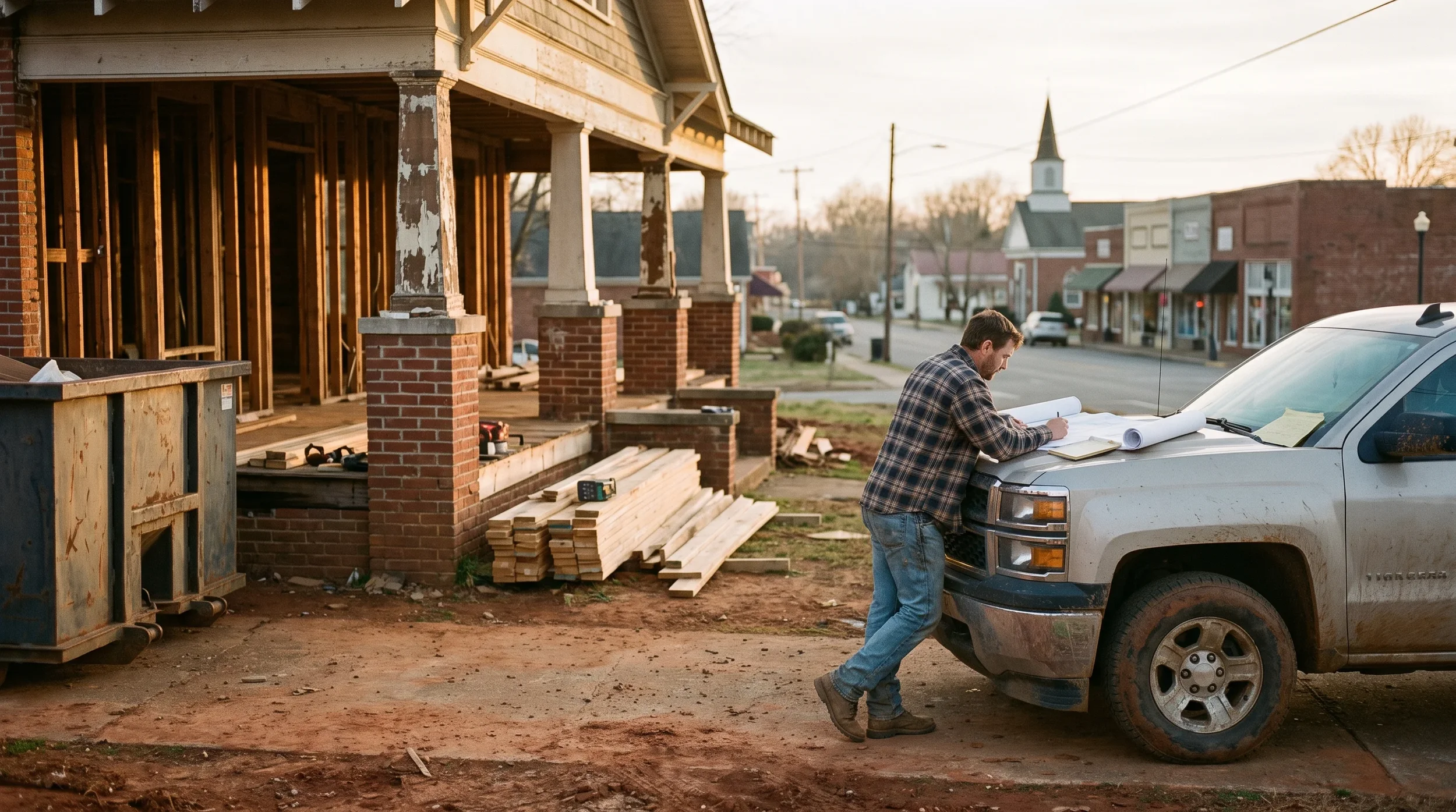
We have seen appraisals come back short because an investor counted a walkout basement as full square footage, and by that point there is no fixing it without renegotiating the whole deal. It happens more in East Tennessee than people expect because sloped lots make finished walkout space feel like living area. The standard appraisers use is ANSI Z765-2021, and it does not care how nice the space looks.
Gross Living Area includes only finished, heated, above-grade residential space. Any space where the finished floor level is even partially below the adjacent ground grade is classified as below-grade square footage, regardless of windows or walk-out access.
On a sloped East Tennessee lot, this matters enormously. A property with 1,400 square feet above grade and an 800-square-foot finished walkout basement is not a 2,200-square-foot home for appraisal purposes. It's a 1,400-square-foot home with below-grade finished space.
How Below-Grade Space Appraises
Finished daylight and walkout basements appraise at 40-60% of the above-grade rate. In established East Tennessee submarkets where above-grade space runs $160 to $240 per square foot, below-grade finished space comes in at roughly $60 to $110 per square foot. Investors who blend the two into a single price-per-square-foot metric routinely over-estimate ARV by $30,000 to $60,000 on sloped lots.
Always evaluate each separately.
The Septic Bedroom Restriction That Can Wreck Your ARV
The bedroom count on your TDEC septic permit is the bedroom count on your appraisal. Outside Knoxville and Chattanooga city limits, that single fact is the most dangerous ARV trap in East Tennessee, and it catches investors who don't check before they build their scope. We check this on every rural deal we underwrite because we've reviewed deals where the bedroom count on the listing didn't match the TDEC permit, and it changed the entire loan structure.
Septic systems are permitted based strictly on the number of legal bedrooms, not square footage or bathroom count.
If you acquire a property permitted for three bedrooms and finish the basement to add two more rooms, you cannot legally market or appraise that property as a five-bedroom home. It lists as a three-bedroom with bonus space, and compared to a legally permitted five-bedroom comp, that costs you $15,000 to $35,000 in ARV.
How to Check Septic Permit Status
Access the TDEC Division of Water Resources Ground Water Protection records portal before you finalize any ARV predicated on adding bedrooms. This confirms the original Subsurface Sewage Disposal System permit and establishes the legal bedroom ceiling. Expanding capacity requires a percolation test by a licensed soil scientist and sufficient reserve drainfield area.
In areas with dense red clay or shallow bedrock, common across East Tennessee's ridge-and-valley geography, soils frequently fail. When they do, the bedroom count is capped permanently, and so is the ARV.
Submarket Nuances: Fix and Flip in East Tennessee by Market Type
Knoxville Urban Infill: Fourth and Gill, Old North Knoxville, Parkridge
These neighborhoods can hit ARV targets of $315,000 to $575,000 for well-executed projects, but they carry regulatory overhead that suburban deals don't. Historic Overlay Districts (H-1) require a Certificate of Appropriateness from the Knoxville-Knox County Historic Zoning Commission before a building permit is issued. Structural alterations, siding changes, and window replacements require formal monthly public hearings: swapping historic wood double-hung sashes for vinyl will be rejected.
Custom millwork and masonry restoration can add $20,000 to $50,000 in construction costs and two to three months of hold time. Budget for it before you make your offer.
Chattanooga
Properties inside Chattanooga city limits carry dual tax levies: Hamilton County and city taxes both apply, compressing buyer purchasing power compared to unincorporated Hamilton County. The combined rate has run near $3.45 per $100 of assessed value. Verify current rates through the Hamilton County Trustee before you close.
Tri-Cities: Johnson City, Kingsport, Bristol
Values here follow conservative parameters set by the healthcare and university workforce economy. Over-improving is a genuine risk. Scope to durable mid-grade and let the comp set confirm your ceiling before you spend a dollar above it.
Sevier County: Gatlinburg, Pigeon Forge, Sevierville
Vacation rental cabins cannot be evaluated using conventional residential comp formulas. ARV is driven by Trailing-12-Month gross rental revenue, capital expenditure condition, and short-term occupancy trends. Well-positioned 2-to-5 bedroom log cabins generate $55,000 to $165,000 or more in annual gross revenues.
Investors apply a cap rate of 7.5% to 8.5%, or a gross rent multiplier against NOI after operating expense ratios of 30-50%. High-yield amenities like an indoor pool or multi-tiered deck can increase gross revenue by $15,000 to $30,000 annually, which compounds under income-cap modeling. One additional risk: non-homestead vacation rentals may be reclassified from the 25% residential assessment ratio to the 40% commercial ratio, which increases carrying costs and softens net yields.
Building the Full Maximum Allowable Offer Stack
The 70% rule gives you a starting ceiling. A fully itemized net-deduction approach gives you precision. Start with ARV, subtract your target net investor margin (typically 12-18% of ARV), then subtract direct rehab, contingency reserve, debt carry, origination points, transaction costs, and Tennessee-specific taxes.
Tennessee imposes a realty transfer tax of $0.37 per $100 of consideration and an indebtedness tax of $0.115 per $100 of debt secured by the deed of trust. These aren't large numbers on a single deal, but they belong in the model.
Run it on a historic urban flip in Knoxville's Fourth and Gill: ARV of $450,000, rehab of $110,000 plus a 20% contingency of $22,000, six-month hold, 10% interest-only carry of $15,750, 2 points of $6,300, disposition costs of $27,000, and a target net margin of $67,500 (15% of ARV). Working backward through that full stack produces a Maximum Allowable Offer near $199,600, or about 44% of ARV. The 70% rule is a ceiling.
In historic or rural deals with elevated cost and timeline risk, the correct multiplier is often 60-65%. Running the full itemized stack tells you exactly where you land, and we walk through it on every deal before we talk numbers with a borrower.
How We Underwrite Fix and Flip Deals at Approach Lending
We've funded more than 300 loans totaling over $53 million through our fix and flip program across East Tennessee, and about 55 to 60% of our borrowers come back for another deal. We're a direct balance-sheet lender: we use our own capital, there's no committee above us, and the terms you agree to on day one don't change at closing. Standard close is 7 to 14 days.
We also fund deals where the remodel budget exceeds the purchase price, a structure most institutional lenders won't touch, and we fund in the tertiary markets most private lenders reject outright: Athens, Oliver Springs, Harriman, Rockwood.
Draws are handled by video inspection only, funded the next day. No invoices, no lien releases, no third-party inspection cycles. Rates run from 9.99% to 12.99% with 2 to 3 points, and the loyalty program gets you to 9.99% plus 1 point after a few deals with us.
If you've got a deal and want to talk through the ARV and the capital stack, call us. That's the fastest way to know whether it pencils.
Frequently Asked Questions
What is the 70% rule for fix and flip in East Tennessee?
Your maximum purchase price should not exceed 70% of ARV, minus estimated repair costs. In East Tennessee, that multiplier shifts: competitive areas like West Knoxville or NorthShore Chattanooga may allow 75-78% of ARV, while historic or rural deals with higher cost and timeline risk often require 60-65%.
How do I calculate ARV for a property in Knoxville or Chattanooga?
Pull 3 to 5 recently sold, renovated comparables from the MLS. Use a 0.25 to 0.5 mile radius in urban submarkets and 1 to 3 miles in rural areas. Adjust each comp for differences in square footage, garage, HVAC, and finish level.
Use only above-grade GLA under ANSI Z765-2021 standards, and prioritize sales that closed within the prior 90 to 180 days.
Does a finished walkout basement add to my ARV in East Tennessee?
Yes, but not at the same rate as above-grade living area. Under ANSI Z765-2021 standards, walkout basements on sloped East Tennessee lots appraise at 40-60% of the above-grade rate, roughly $60 to $110 per square foot versus $160 to $240 for above-grade GLA. Blending the two into a single price-per-square-foot figure is one of the most common ARV errors in this market.
Can I add bedrooms in a fix and flip if the property is on a septic system?
Only if the existing TDEC permit supports the additional bedroom count. Tennessee law ties legal bedroom count to the septic permit, not to finished square footage. Adding bedrooms beyond permitted capacity means you cannot advertise or appraise those rooms as legal bedrooms, reducing your ARV by $15,000 to $35,000 compared to legally permitted comps.
Check the TDEC Ground Water Protection records portal before you build your rehab scope.
What does Approach Lending lend on fix and flip deals in East Tennessee?
We lend up to 70% of ARV, with rates from 9.99% to 12.99% and 2 to 3 points. Standard close is 7 to 14 days. We fund deals in Knoxville, Chattanooga, and smaller East Tennessee markets including Athens, Oliver Springs, Harriman, and Rockwood, including deals where the rehab budget exceeds the purchase price.